
When Should You Hire a Director of SEO for Your Company?
Key Takeaways
- Strategic Growth Catalyst: A Director of SEO transitions search from an isolated execution channel into an enterprise revenue driver by aligning technical roadmaps with executive growth goals.
- Timing Is Everything: Hire at the director level when organic search meaningfully impacts top-line revenue, cross-functional dependencies increase, and execution complexity exceeds manager capacity.
- Focus on Executive Skills: Evaluate candidates primarily on business acumen, team development, P&L responsibility, and cross-departmental influence rather than routine technical auditing skills.
- Structured 12-Month Horizon: Director-level hires require a realistic 90-day discovery window followed by a structured 12-month roadmap to build sustained, compounding channel equity.
Introduction
You should hire a Director of SEO when search has become central enough to your revenue model that it requires executive oversight, cross-departmental alignment, and multi-year strategic planning. Bringing on leadership at this level is an organizational milestone. Unlike hands-on specialists or channel managers, a director acts as a business leader who translates organic search potential into enterprise value.
Knowing when to make this hire prevents two costly mistakes: hiring too early when tactical execution is all you actually need, or waiting too long and allowing cross-functional friction to stall your organic growth. When paired with reliable seo management services, an executive director provides the vision and governance required to turn organic search into a predictable growth channel.
The Role of a Director of SEO vs. Tactical Leadership
Understanding the distinction between execution roles and strategic executive roles is essential before writing a job description. While specialists fix crawl errors and managers oversee daily publishing schedules, a Director of SEO leads the overarching program vision.
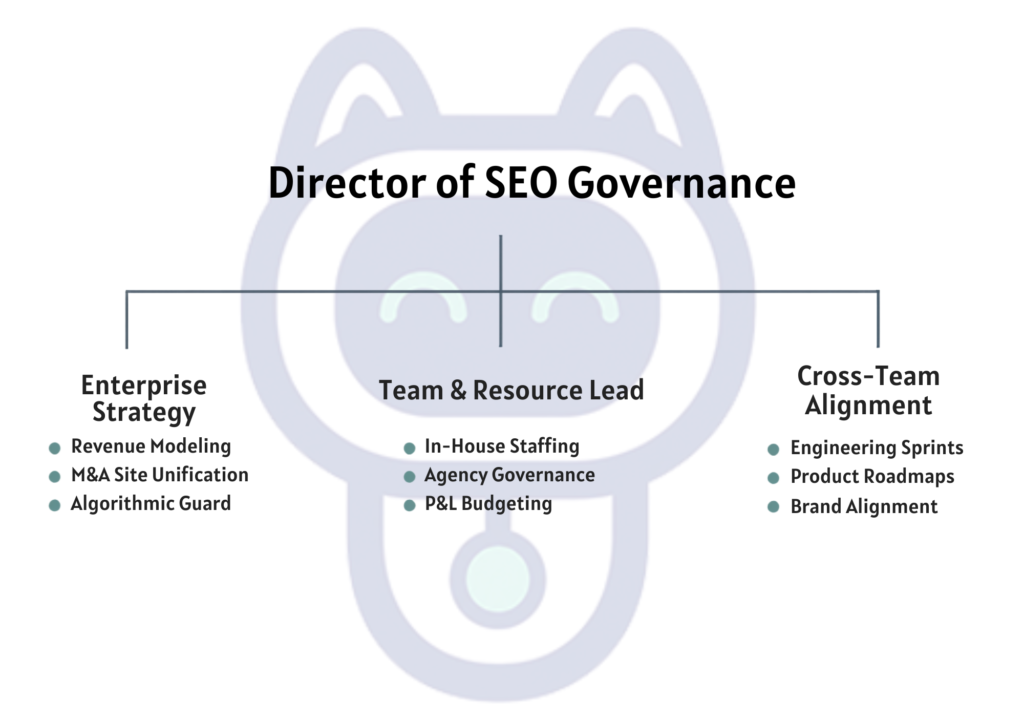
Strategic Ownership Areas
- Executive Resource Allocation: Securing engineering sprints, design resources, and content budgets by demonstrating clear return on investment to executive leadership.
- Portfolio & Site Architecture Governance: Managing complex site migrations, multi-brand unifications, international web structures, and programmatic search frameworks.
- Cross-Departmental Integration: Embedding search requirements directly into product development cycles, brand marketing campaigns, and technical infrastructure updates.
Evaluating Organizational Readiness: Hard Metrics vs. Early Signals
Not every growing company requires an executive director immediately. In early growth stages, businesses often gain better ROI by combining internal marketing leads with specialized SEO expert services or affordable SEO services to handle tactical execution.
The table below outlines key indicators to help determine whether your company is ready for director-level leadership or if you should maintain a managerial structure:
| Organizational Indicator | Ready for a Director of SEO | Better Suited for Manager / Specialist |
| Revenue Impact | Organic search directly drives 30%+ of total business pipeline or ARR | Organic search represents an emerging or unproven lead channel |
| Team Complexity | Managing multiple in-house specialists, agency partners, and content vendors | Single specialist or outsourced contractor handling day-to-day execution |
| Technical Bottlenecks | Search initiatives stall due to competing engineering, product, or design priorities | Updates only require basic CMS edits and routine on-page optimizations |
| Strategic Horizon | Building multi-year organic growth strategies, international expansion, or site unifications | Focused primarily on short-term keyword targeting and quarterly publishing |
Candidate Vetting Framework: Beyond Technical Trivia
When interviewing executive candidates, avoid spending time on technical trivia or memorized platform mechanics. Senior leaders are hired for business judgment, team development capability, and strategic vision.
Key Evaluation Criteria
- P&L and Revenue Accountability: Ask candidates to demonstrate how they have previously tied search performance directly to customer acquisition costs (CAC), lifetime value (LTV), and pipeline velocity.
- Influence Without Direct Authority: A director must convince product leads and engineering managers to prioritize search tickets. Evaluate how candidates navigate organizational trade-offs and resolve cross-team conflicts.
- Vendor and Agency Management: Inquire about their experience auditing external partners, restructuring agency retainers, and optimizing team productivity.
Interview Questions Worth Asking
- “How do you justify a major technical search initiative to a CTO when engineering resources are tight?”
- “Walk us through a scenario where an algorithmic update severely impacted your domain. How did you diagnose the issue and lead the executive response?”
- “How do you determine the optimal mix between hiring in-house specialists and engaging specialized external agencies?”
Structuring the First 12 Months for Maximum Impact
Setting realistic expectations prevents executive burnout and ensures long-term strategic alignment. A Director of SEO requires a structured ramp-up period to deliver sustainable organizational changes:
- Months 1–3 (Discovery & Governance): Perform deep site architecture audits, evaluate team workflows, establish baseline data tracking in GA4/GSC, and build relationships with engineering and product leads.
- Months 4–6 (Roadmap Execution & Resourcing): Finalize the multi-year search roadmap, reallocate retainer budgets, implement high-priority technical fixes, and introduce standardized content briefing templates.
- Months 7–12 (Scaling & Compounding Equity): Measure early pipeline growth, refine cross-departmental sprint workflows, evaluate international or programmatic expansion opportunities, and present channel contribution metrics to the board.
Conclusion
Hiring a Director of SEO is a strategic investment that transitions search from an isolated marketing tactic into a predictable engine for enterprise revenue. By accurately evaluating your organizational readiness, focusing candidate interviews on executive leadership rather than routine tactics, and establishing a structured 12-month onboarding plan, executive leaders can position their search programs for sustainable market dominance.
Frequently Asked Questions
What is the primary difference between a Director of SEO and an SEO Manager?
An SEO Manager oversees daily execution, content briefing, and technical task delivery. A Director of SEO focuses on executive strategy, resource allocation, managing managers and agencies, securing engineering resources, and tying search metrics directly to company revenue.
Should a Director of SEO report to Marketing or Product?
In most organizations, the Director of SEO reports to the Chief Marketing Officer (CMO) or VP of Marketing. However, in product-led growth (PLG) companies or large e-commerce platforms where search depends heavily on web engineering, reporting through Product or Technology can also be effective.
How much does it cost to hire a Director of SEO in the United States?
In the US market, base salaries for a Director of SEO typically range from $150,000 to $230,000+ annually, depending on company scale, location, and equity/bonus structures.
How long does it take to fill a senior executive search role?
Executive searches for director-level marketing talent typically require 3 to 6 months. This timeline accounts for candidate sourcing, multi-stage strategy presentations, stakeholder interviews, reference verification, and notice periods.
Can an external agency replace the need for a Director of SEO?
Agencies provide valuable execution and specialized insight, but they rarely replace internal executive leadership. A Director of SEO serves as the internal advocate who navigates company politics, secures developer resources, and embeds search strategy across departments.
Book a Strategy or Discovery Call
Evaluating whether your organization is ready for executive search leadership or looking to structure your growth roadmap? We provide transparent, data-driven strategy sessions tailored to enterprise business goals.
Book a Strategy Call today to review your search architecture, assess team resourcing options, and build an actionable roadmap for sustained organic growth.